
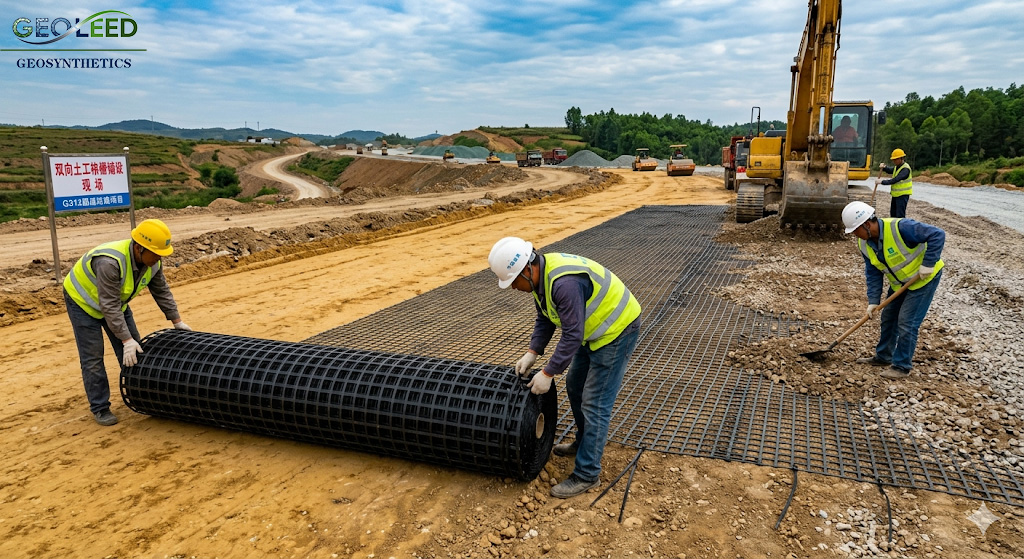
In roadbed engineering, Biaxial Plastic Geogrids (typically made of Polypropylene/PP) function as the “skeletal reinforcement” of the soil. They transform weak subgrades into a stable reinforced composite mattress.
Here are the four core mechanisms of their application:
1.Lateral Restraint and “Interlocking” Effect
This is the most critical function. When aggregate or soil is compacted over the geogrid, the particles settle into the grid apertures.
Mechanical Interlock: The stiff ribs of the geogrid restrict the lateral movement of soil particles (preventing them from “spreading” sideways).
Friction: This interlocking creates a unified structure that significantly increases the shear strength of the roadbed.
2.Load Distribution and Stress Reduction
Without reinforcement, wheel loads concentrate directly on the subgrade, often causing localized failure.
The “Tensioned Membrane” Effect: The geogrid converts vertical pressure into horizontal tensile stress, spreading the load over a much wider area.
Pressure Reduction: By distributing the load, it reduces the vertical pressure on the underlying soft soil, preventing ruts and surface cracking.
3.Mitigation of Differential Settlement
In areas with soft soil (silt, peat) or at transition zones (cut-and-fill sections), uneven settling is common.
High Tensile Stiffness: Since biaxial grids provide equal strength in both longitudinal and transverse directions, they act as a “stiff platform.”
Homogenization: The grid ties the roadbed together, forcing the structure to settle uniformly rather than allowing localized “sinkholes.”
4.Practical Implementation & Benefits
Cost Efficiency: Using geogrids can reduce the required thickness of the aggregate base by 20% to 40% while achieving the same load-bearing capacity.
Sustainability: It allows for the use of lower-quality local fill materials that would otherwise be unsuitable without reinforcement.
TRI Testing Relevance: For critical projects, TRI testing verifies that the plastic grid won’t lose its “interlock” stiffness over time, ensuring the road remains smooth for its intended design life.
Summary in Two Sentences
Biaxial plastic geogrids stabilize roadbeds by providing lateral confinement and superior load distribution through a mechanical interlocking mechanism with the soil. This reinforcement significantly reduces differential settlement and extends the pavement’s service life, especially over soft or unstable subgrades.Customer Benefits:
Eliminate chemical leaks caused by impurities
Protect foundation settlement and ensure no cracking for 20 years
Longer lifespan in high-temperature wastewater environments