
In railway engineering, geogrids are subject to much stricter requirements than in road construction due to the high-frequency dynamic loads, intense vibrations, and the zero-tolerance policy for differential settlement—especially in High-Speed Rail (HSR).
Here are the three core applications:
1.Ballast Reinforcement and Confinement
This is a specialized application unique to railways. Geogrids are placed within or at the bottom of the ballast layer (the crushed stone supporting the sleepers).
Mechanism: The geogrid apertures lock the ballast particles in place through a mechanical interlock.
Benefit: It prevents the lateral spreading of ballast caused by the rhythmic heavy impact of passing trains. This maintains track geometry and significantly extends the intervals between “ballast tamping” (maintenance).
2.Subgrade Stabilization and Load Distribution
Railways require an extremely stiff platform to prevent track deformation.
Mechanism: By installing high-modulus geogrids (such as Geoleed PET series) in the sub-ballast or embankment layers, a “tensioned membrane” is created.
Benefit: It spreads the massive concentrated load of the locomotive over a wider base, reducing the pressure on soft underlying soils and preventing “mud pumping” (the upward migration of fine soil into the ballast).
3.Bridge-to-Embankment Transition Zones
The transition between a rigid bridge structure and a relatively flexible soil embankment is a frequent failure point.
Mechanism: Layers of geogrid are used to create a “graduated stiffness” zone.
Benefit: This minimizes the sudden change in settlement, eliminating the “bump” at the end of the bridge and ensuring smooth high-speed transitions.
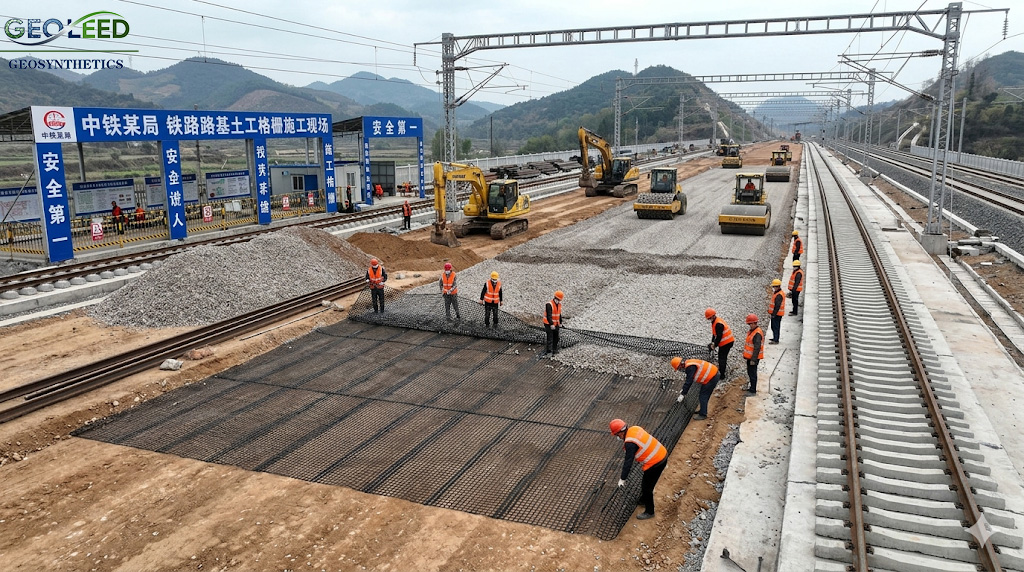
Why Quality Standards (Geoleed & TRI) Matter in Rail
Since railway infrastructure is designed for a 100-year service life, the selection of materials is critical:
Dynamic Fatigue Resistance: Unlike roads, railway geogrids must withstand millions of load cycles. TRI testing verifies that the junctions (nodes) of the grid will not break under repetitive vibration.
Low Long-term Creep: Using Geoleed polyester (PET) grids ensures that the reinforcement won’t stretch over decades. TRI-certified data provides the exact reduction factors ($RF$) needed to guarantee structural integrity for over a century.
Summary
In railway subgrades, geogrids act as a structural stabilizer. By confining the ballast and stiffening the soil foundation, they ensure the precision of the track geometry and the safety of high-speed operations under extreme dynamic stress.